

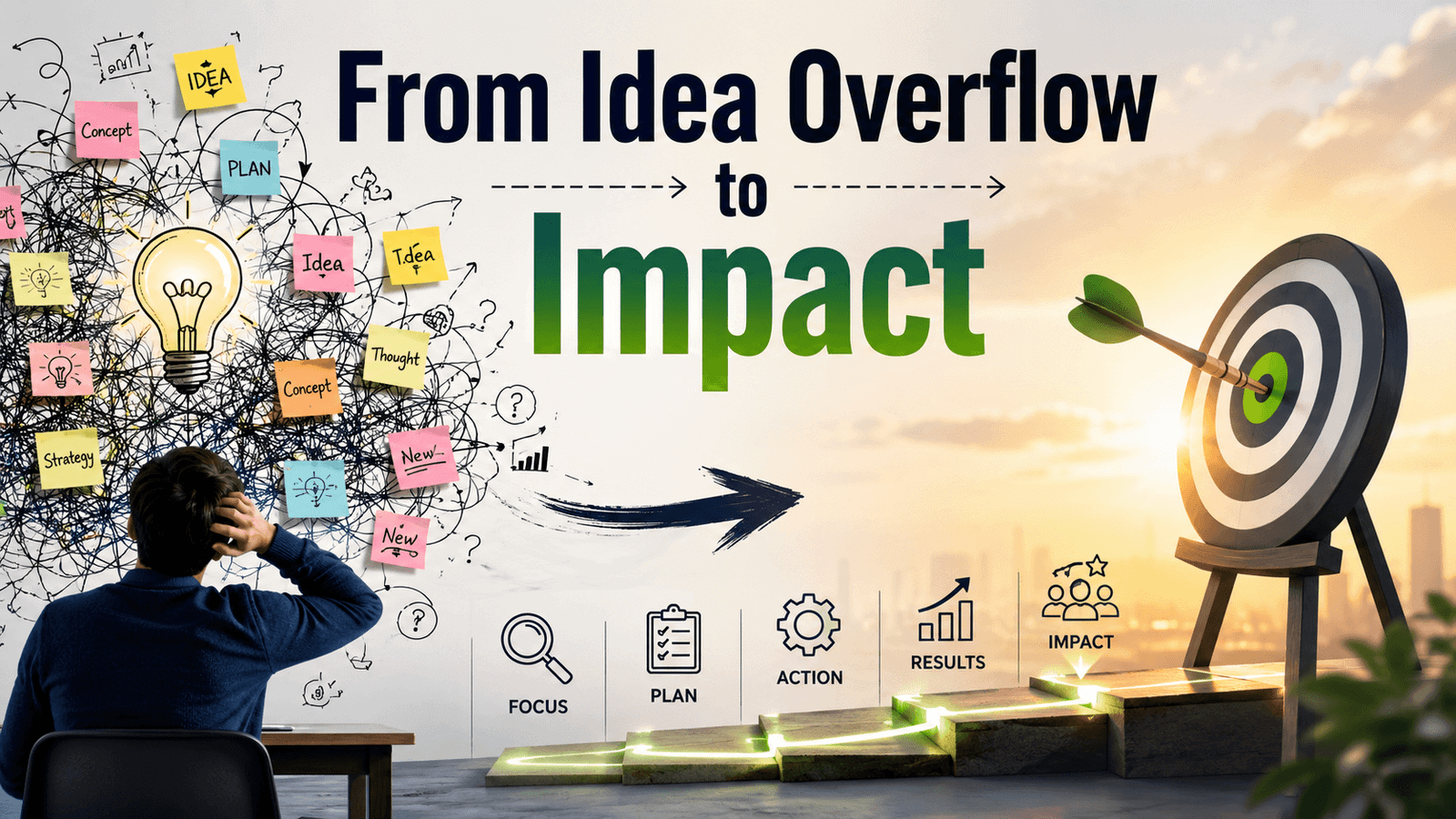
Having plenty of ideas can feel like a gift, but too many ideas can quickly become a source of frustration. From Idea Overflow to Impact is about moving beyond endless brainstorming and learning how to turn promising thoughts into useful, measurable results.
Many creative people struggle not because they lack imagination, but because they have more possibilities than they can realistically pursue. New ideas continue arriving before earlier ones have received enough attention to become something real.
What Does From Idea Overflow to Impact Really Mean?
From Idea Overflow to Impact describes the journey from having a large collection of possibilities to creating something that genuinely helps people. An idea has potential, but impact comes from applying that idea to a real problem.
This distinction matters because ideas alone do not create change. A notebook filled with brilliant concepts has no practical value until someone chooses one, develops it, tests it, and puts it in front of the people who may benefit from it.
The process does not require abandoning creativity. Instead, it requires giving creativity a structure. The goal is to preserve curiosity while creating enough discipline to move selected ideas forward.
| Quick Overview | Details |
|---|---|
| Topic | From Idea Overflow to Impact |
| Main Challenge | Too many ideas and too little execution |
| Core Skill | Prioritization and focused action |
| Key Goal | Turning useful ideas into practical outcomes |
| Best Approach | Select, test, build, measure, and improve |
Why Idea Overflow Can Become a Problem
A constant stream of ideas can make every new possibility seem exciting. When everything feels important, however, choosing what deserves attention becomes surprisingly difficult.
People may start several projects at once, switch between different plans, or spend more time researching possibilities than actually building anything. Eventually, unfinished work begins to pile up.
Another problem is decision fatigue. Every unfinished idea creates another mental commitment. Even when nothing is actively being worked on, those unfinished possibilities can continue demanding attention.
This is why From Idea Overflow to Impact begins with selection rather than execution. Before asking how to build something, it is important to decide what is genuinely worth building.
Start by Capturing Every Idea
The first practical step is to create a single place where ideas can be recorded. This could be a notebook, document, notes application, or simple spreadsheet.
The purpose is not to evaluate ideas immediately. Capture them quickly and return to the creative work that produced them. This prevents interesting thoughts from interrupting current priorities.
A reliable capture system also reduces the fear of forgetting something valuable. Once an idea has been safely recorded, there is less pressure to act on it immediately.
Over time, this collection becomes a personal idea library. It gives you permission to say, “Not now,” without having to say, “Never.”
Separate Exciting Ideas From Valuable Ideas
Not every exciting idea deserves to become a project. Some ideas are interesting because they are new, while others are valuable because they solve a meaningful problem.
When reviewing your ideas, consider the problem behind each one. Ask who would benefit, how serious the problem is, and whether the proposed solution could realistically improve the situation.
You should also consider your available resources. Time, knowledge, money, skills, and access to the right audience can all influence whether an idea has a realistic path forward.
A simple question can be especially useful: Would this still matter if the excitement disappeared tomorrow? If the answer is yes, the idea may deserve deeper consideration.
Choose One Clear Direction
The move From Idea Overflow to Impact becomes much easier when attention is concentrated on one meaningful objective. Choosing one direction does not mean your other ideas are worthless.
It simply means they are being placed aside temporarily. A strong idea can wait, while a weakly executed project may lose its opportunity because attention was divided too widely.
Choose an idea that combines usefulness, feasibility, and personal commitment. When these three factors overlap, the chances of sustained progress become much stronger.
A clear direction also makes decisions easier. Instead of asking whether every possible action is worthwhile, you can ask whether it supports the chosen objective.
Turn the Idea Into a Small Experiment
Large projects often become intimidating because the imagined final result is too complicated. A better approach is to create the smallest useful version of the idea.
This could mean producing a basic prototype, publishing a short guide, testing a service with a few people, or creating a simple demonstration.
The purpose of an early experiment is learning. You do not need everything to be perfect before receiving feedback. In fact, early feedback can prevent months of work from being invested in the wrong direction.
Small experiments also create momentum. Completing one manageable step feels very different from constantly planning a massive project that never reaches completion.
From Idea Overflow to Impact Requires Feedback
Once an idea reaches the real world, other people can reveal weaknesses that are difficult to notice alone. Their questions, reactions, and experiences provide valuable information.
Feedback should not automatically be treated as criticism. Sometimes a confusing response simply shows that an idea needs clearer communication.
Pay attention to repeated patterns rather than isolated opinions. If several people struggle with the same part of a product, service, article, or project, that pattern deserves investigation.
The strongest creators are often willing to change their original approach. The goal is not to protect an idea exactly as imagined, but to make the final result more useful.
Build a System for Finishing Ideas
Creativity becomes more productive when it is supported by simple routines. Set a limit on active projects and create specific times for reviewing your idea collection.
For example, you might allow yourself one major project and one smaller experiment at a time. New ideas can still be captured, but they do not automatically become new commitments.
Regular reviews are equally useful. Every few weeks, examine your stored ideas and decide whether they should be developed, postponed, combined with another concept, or removed.
This system creates space for creativity without allowing every new thought to control your schedule.
Measure the Impact, Not Just the Activity
Completing tasks can feel productive, but activity is not always the same as progress. From Idea Overflow to Impact ultimately requires looking at what changed because of the work.
The right measurement depends on the project. It could involve customers helped, problems solved, money earned, time saved, people reached, skills developed, or another meaningful result.
Measurement should remain simple enough to use consistently. If tracking results becomes more complicated than the project itself, the system may need to be reduced.
The important question is straightforward: What evidence shows that this idea is making a difference?
Common Mistakes That Keep Ideas Stuck
One common mistake is waiting for perfect conditions. There is rarely a perfect moment, perfect plan, or complete understanding before meaningful work begins.
Another mistake is constantly changing direction. A new idea can feel more exciting than a difficult project that has entered its less glamorous stage.
Some people also confuse preparation with progress. Research, planning, organizing, and learning are useful, but they should eventually lead to action.
Finally, trying to develop every idea at once usually weakens the quality of all of them. Focus creates depth, while excessive switching creates unfinished work.
How to Make the Journey Sustainable
The transition From Idea Overflow to Impact should not depend on motivation alone. Motivation changes, but a simple working system can continue operating during less productive periods.
Create clear project boundaries, define the next physical action, and decide what completion looks like before beginning. These small decisions reduce uncertainty.
It is also important to protect time for creative thinking. A structured approach should not eliminate experimentation. Instead, it should make experimentation safer by giving new ideas a controlled place.
With time, you learn that not every idea needs to become a finished project. Some ideas exist to inspire another idea, improve an existing project, or simply expand the way you think.
Conclusion
From Idea Overflow to Impact is ultimately a lesson in choosing rather than collecting. Having many ideas is valuable, but meaningful results come from giving selected ideas enough attention to become real.
Capture your thoughts, identify the ideas with genuine value, choose a clear direction, start with a small experiment, listen to feedback, and measure what changes.
The objective is not to become less creative. It is to make creativity more useful. When ideas receive focus, action, and continuous learning, the distance between imagination and real-world impact becomes much smaller.
FAQs About From Idea Overflow to Impact
What is From Idea Overflow to Impact?
From Idea Overflow to Impact refers to the process of transforming a large number of ideas into focused projects that create practical and meaningful results.
How do I manage too many ideas?
Keep all new ideas in one dedicated place instead of acting on them immediately. Review them regularly and select only those that are useful, realistic, and worth pursuing.
Should I work on several ideas at once?
Working on too many ideas simultaneously can divide attention and slow progress. Limiting active projects can make it easier to maintain quality and finish meaningful work.
How can I know which idea deserves attention?
Look at the problem it solves, the people who may benefit, the resources required, and your ability to execute it. Ideas with strong usefulness and realistic potential deserve closer attention.
What is the first step from an idea to a real result?
Start with a small experiment. A simple prototype, test, sample, or early version can provide practical information before you invest heavily in the full concept.
Can an unfinished idea still be useful?
Yes. An unfinished idea can provide inspiration, reveal a new opportunity, or contribute to another project. The important thing is to store it intentionally rather than allowing it to create constant mental pressure.
